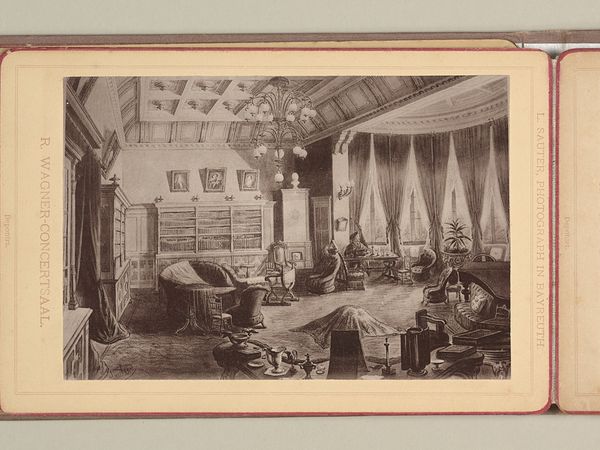
Some museum objects impress with their size. Others tell their story in pocket-sized form. Among them is this small accordion-fold booklet containing twelve postcards, which has been part of the Richard Wagner Museum’s collection since 1936 and is currently being highlighted in the exhibition “150 Years of the Bayreuth Festival—We’re Celebrating Too.” It is titled “Memories of Bayreuth”—and once belonged to the American opera singer Minnie Hauk, one of the most celebrated prima donnas of her time.
Anyone reading her name might assume that she worked with Richard Wagner in Bayreuth. In fact, Minnie Hauk was already present at the first festival in 1876—though not as a singer, but as a guest. At that time, Europe’s cultural and social elite gathered at the Festspielhaus, which had been built specifically for that purpose. Among those in the audience were Emperor Wilhelm I, King Ludwig II of Bavaria, and composers and intellectuals such as Anton Bruckner, Pyotr Tchaikovsky, Friedrich Nietzsche, and Franz Liszt. The program featured the complete world premiere of Wagner’s four-part opera cycle “Der Ring des Nibelungen”, on which he had also worked during his stay in Tribschen (1866–1872).
It is surprising that Minnie Hauk was not on stage. After all, she was one of the most prominent performers of her time. Wagner is even said to have described her, after a performance of “The Flying Dutchman”, as the best Senta he had ever heard. The conductor of the “Ring” premiere, Hans Richter, therefore offered her the role of Sieglinde in “Die Walküre”—one of the most tragic and emotionally charged characters in Wagner’s “Ring”—a role with a somewhat delicate backstory: She is not only the mother of the legendary hero Siegfried, but also the twin sister of her child’s father, Siegmund. Minnie Hauk’s mother did not consider this incestuous role suitable for her daughter—and forbade her from taking it on.
The singer thus experienced the first Bayreuth Festival from the audience. She remained closely connected to Bayreuth, however. The Leporello likely dates from a later stay in 1899. By that time, Minnie Hauk had already been living for about ten years with her husband, Ernst von Hesse-Wartegg, at Schlössli Wartegg, not far from the Landhaus Tribschen, where Wagner had once lived. To this day, the Minnie-Hauk-Weg, located directly below Schlössli Wartegg, commemorates the singer.
The small Leporello is thus far more than just a pretty travel souvenir: it tells the story of the surprising connection between Wagner’s Bayreuth, Tribschen, and one of the most significant singers of her time.