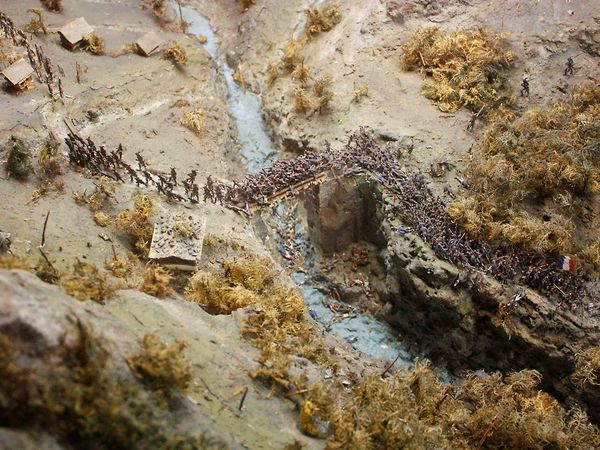
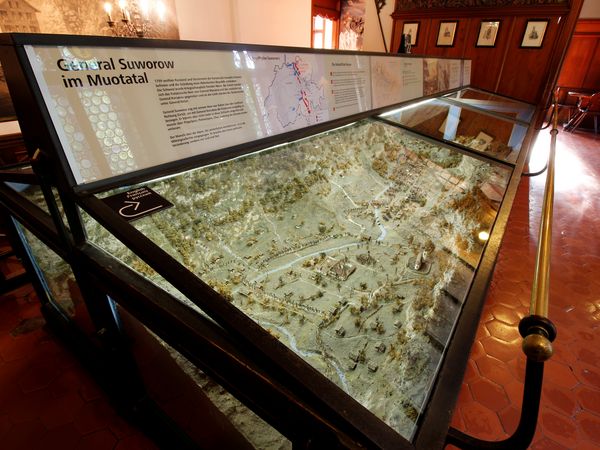
The military encounter between the two armies is impressively documented in a historical landscape model in the Glacier Garden. The fighting troops are represented by tin soldiers. The relief shows various phases of the fighting that took place on October 1, 1799. It was created over a period of two years by Josef Sigmund Nideroest (1780-1854) from Schwyz, an eyewitness to the battle. As a young man, he watched the battle from the heights near the village of Illgau. The relief was shown on lecture tours in various European cities and met with great interest in military circles. It eventually found its way to the Maria Hilf College in Schwyz. When the badly damaged relief was put up for sale, Joseph Wilhelm Amrein-Troller decided to purchase it and exhibit it in the Glacier Garden in Lucerne, which opened in 1873.
Interestingly, purchase negotiations took place in 1901/02 between the Suvorov Museum in St. Petersburg and the Glacier Garden in Lucerne. Apparently, 200,000 rubles were offered, which at the time was equivalent to over CHF 500,000. Fortunately, the sale did not go through, and the Glacier Garden in Lucerne remained in possession of this unique piece.