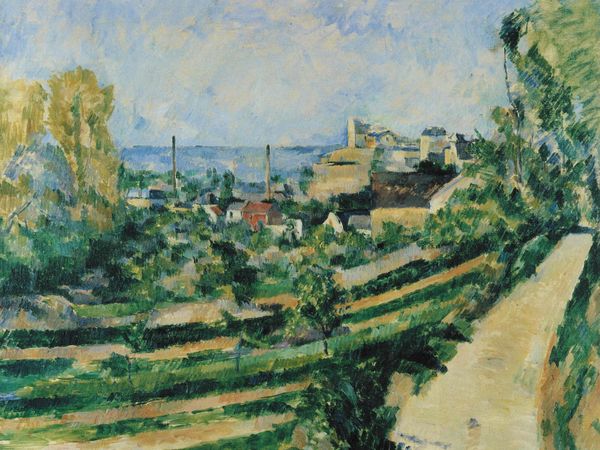
The French painter Paul Cézanne (1839–1906) returned time and again to L’Estaque, a Provençal fishing village north of Marseille. In this painting, he depicted for the first time the Saumaty Tower, situated on a hill and towering over all the other buildings, as well as the chimneys of the brickworks. With the help of the deciduous trees framing the wide-format composition on the left and right, he gives the composition a vertical structure. Indeed, the vegetation, painted in layers of green and yellow with diagonal brushstrokes, begins on the left and rises diagonally toward the end of the path. Unlike the Impressionists, he did not depict a fleeting moment here, but rather a clearly structured, internally ordered, architectural composition. This becomes particularly evident when compared to the works of artists such as Pissarro, Monet, and Renoir, which can also be found in the Rosengart Collection. In this view, with the sea stretching out at the very back of the horizon, Cézanne once again demonstrated his ability to depict the structural simplification of the landscape in a highly balanced composition. A circular movement is created that runs to the right, inviting the viewer to follow the path deep into the picture and mentally stroll far into the Mediterranean landscape, feeling the often strong Mistral wind and the oscillating light of a sunny day. Contrary to his own view, he was certainly able to capture here “the intensity that unfolded before his senses and the wonderful richness of color that animates nature” (Paul Cézanne).
Masterpieces
Paul Cézanne: «L’Estaque, le village et la mer»