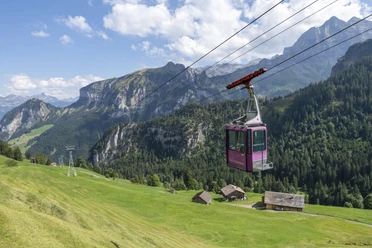
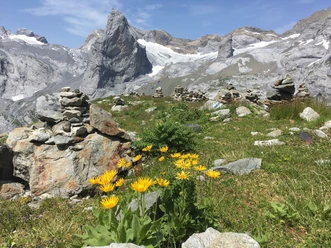
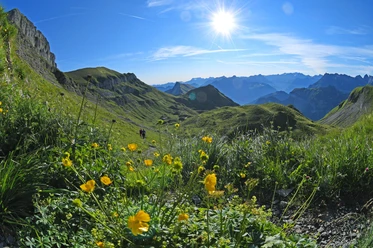
From the charming sunny terrace of Isenthal, Gitschenen (1538 m) hike down via Lauwelital to St. Jakob (969 m). From here, the route follows the valley floor along the natural road to the extensive Chimiboden. Then the path leads through a shady spruce forest to Steinhüttli (1400 m). There is a rewarding view of the rock walls below the castle and Gross Rimistock with an impressive view of the break-off of the Schlossfirn glacier.
Across the streams and debris slopes in Bösenboden and through the spruce forest in Hangbaum, we reach the alpine pastures in Wilderbutzen. In the eponymous Stafel, there is a good view of the opposite side of the valley with Schlossstock, Chaiserstuel and the teeth of the Oberalper ridge with the Tor. Then the path leads to the Biwaldalp restaurant (1694 m).
- Technical difficulty level: T2 white-red-white
- 4:30 h
- 12.10 km
- 836 m
- 670 m
- 966 m
- 1,727 m
- 761 m
- Start: Gitschenen/ St. Jakob (municipality Isenthal)
- Destination: Biwaldalp
Pavements
- Unknown (4%)Asphalt (2%)Trail (71%)Path (23%)
Best to visit
- suitableDepends on weather
Directions
- Gitschenen - Lauwelital - St. Jakob - Chimiboden - Steinhüttli - Wilderbutzenstafel - Biwaldalp
Tour information
Mountain summit
Nature highlight
Refreshment stop
Equipment
- Sturdy hiking boots with grippy soles, weather-appropriate equipment, topographic maps (not just a smartphone), compass and altimeter are part of the basic equipment.
- Additionally, the basic equipment also includes a first aid kit, emergency blanket and mobile phone for emergencies.
- Hiking poles are very helpful, especially with a heavy backpack.
- For alpine hiking trails, depending on the stage, ropes, harnesses, ice axes and crampons are recommended.
Directions & Parking facilities
- Public transportation
This hike is possible as a day stage.
Isenthal is well accessible by public transport.
For a day hike, you can travel by public transport to Isenthal St. Jakob. Then walk to Biwaldalp as described in the route. From there there is a path back to Isenthal St. Jakob. This is a nice circular route.
Additional information
- www.alpenkranz.ch
- Accommodation for stage 2; Biwaldalp:
During the summer months, the Biwaldalp alpine pasture is managed and the cow's milk is processed into fine alpine cheese. In the restaurant, you can enjoy a fine morning snack plate with a view of the mountains. There is also the possibility to stay overnight on the alp.
Information about the Uri experience region can be found here: www.uri.swiss
Book your accommodation in the Uri experience region: www.uri.swiss/de/planen/unterkuenfte/
Local mountain guides & qualified hiking leaders can be found at: Montanara Bergerlebnisse, Mountain Guide Association Uri and Honigberg.ch
Literature
Author
Sanna Laurén
Organization
Verein Urner Wanderwege
Author´s Tip / Recommendation of the author
Tip:
Shorter version: For this, follow the small road from St. Jakob downhill to the Rüti junction and then climb through the large forest to the Witental at Ober Rüteli. The subsequent ascent to the Biwaldalp restaurant (1695 m) calls for refreshments and a good coffee together with homemade alpine yogurt.
Overnight stay at the authentic alpine farm "Biwaldalp". Wonderful evening atmosphere with a fantastic view of the mountain scenery in the middle of the Uri Rotstock national hunting ban area.
Option:
Combine the hike with a detour to the Uri Rotstock - a summit tour with fantastic panoramic views (T4).
A marked mountain path runs along the Schlierens slope above the Wilder Butzen alp to the Hochegg signpost (1877 m). Then the path ascends over Breitplanggen, Hangbaum and Mälchböden to the large moraine of the Blüemlisalp glacier and the Gitschenhöreli hut.
From there, there are two ways to reach the summit. One more difficult route with ladders and chains. And a simpler route through the moraine (both T4).
The unattended private hut "Gitschenhöreli" is closed.
Reservation and door code:
A. and E. Bissig, Spätach 7, 6472 Erstfeld Tel. +41 (0)41 880 28 62, Tel. +41 (0)79 612 90 25.
Safety guidelines
Alpine and mountain hiking is demanding. Knowledge of dangers in the mountains (rockfall, slipping/falling hazard, weather change) is necessary for mountain and alpine hiking trails. Sturdy hiking boots with grippy soles, weather-appropriate equipment, topographic maps (not just a smartphone), compass and altimeter are part of the basic equipment. For alpine hiking routes, ropes, ice axes and possibly crampons are additionally recommended. The basic equipment also includes a first aid kit, emergency blanket and mobile phone for emergencies.
It is recommended to do serious tour planning and careful preparation for every hike. The weather in the mountains can change very quickly. Fog can also make orientation difficult in summer. The greatest danger in summer besides heat is thunderstorms. Thunderstorms with heavy rain and hail quickly turn small streams into large rivers and increase the danger of mudslides and rockfall. Therefore, it is important to interpret the weather report when planning tours. Thermal thunderstorms often come only in the afternoon, but frontal thunderstorms can occur at any time of day. In general, it is worthwhile to start early in summer.
Mountain guides or qualified hiking leaders (up to T4) are recommended for alpine hiking trails (white-blue-white marked routes), hiking leaders for hikes and mountain hikes. They take over the organization and planning of the tours so that guests can easily enjoy the hike.
The Uri hiking planner and the Uri Outdoor app help with planning. Via Geo Admin, you can find many useful information such as where pastures with herd protection dogs, suckler cow pastures and also wildlife resting zones are located.
Hikers hike at their own risk. The Urner Wanderwege association is not liable for accidents that occur during the Urner Alpenkranz hikes.
Map
The hiking and biking map of the canton of Uri, Urnersee sheet
The "Urnersee" sheet is available in the web shop of Urner Wanderwege: www.urnerwanderwege.ch/de/shop