Glacial Erratics Trail


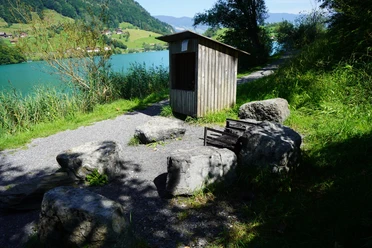
Attentive observers will notice boulders in the meadows that do not match the local geology composed of limestone and marl rocks (sedimentary rocks). Among the boulders on Blattisturren, for example, one gets the feeling of being in the Grimsel area with its granites and gneisses (ancient rocks). This also caught the attention of our (geological) ancestors who called such boulders erratics (= misplaced stones). They are also known as glacial erratics or colloquially as Geissberger. But how did massive boulders from the Grimsel area get to Lungern?
About 20,000 years ago, during the maximum glaciation of the last ice age, an arm of the Aare Glacier flowed over the Brünig towards Lucerne far into the Swiss Plateau. The valley was at times covered by ice over 1700 m above sea level. The glacier carried debris on its back as well as larger rockfalls from its catchment. About 15,000 years ago, as the ice slowly melted and retreated over the Brünig during the warm period we still live in today, it left this sediment load as a souvenir. Some witnesses of the past cold period can still be admired today. Many have, however, been covered by natural processes such as rockfalls and mudflows or destroyed by human activities. Often the boulders were used as quarries for building due to their solid stone. Sometimes they had to give way to more efficient agricultural use. So let us enjoy the remaining geological witnesses.
- 3:41 h
- 11.93 km
- 461 m
- 461 m
- 689 m
- 1,027 m
- 338 m
- Start: Lungern Train Station
- Destination: Lungern Train Station
Waypoints
Good to know
Best to visit
- suitableDepends on weather
Tour information
Circular trail
Directions & Parking facilities
- Public transportation
Current timetables at: www.zentralbahn.ch
Author
Obwalden Tourismus
Organization
Obwalden Tourismus
Author´s Tip / Recommendation of the author
- Part of the path leads through the beautiful natural paradise of Brünig-West. In the months of June/July, over 100 species of butterflies can be observed.
Nearby


Download GPX file